
Share this post
We recently hosted an educational webinar exploring Alberta’s Bill 30 and the significant changes it introduces to condominium governance. The session was led by Kate Kozowyk, partner at SVR Lawyers, who walked us through both the legislative updates and how these new changes impact condominiums.

Kate’s legal practice focuses on professional negligence matters, condominium law and personal injury matters, including social and commercial host liability. She has appeared at all levels of Court in Alberta, including the Alberta Court of Appeal and has been involved in an Application for Leave to Appeal to the Supreme Court of Canada.
Kate acts for individuals, boards of directors, property managers and developers with respect to various condominium matters, including insurance claims, bylaw creation and interpretation, bylaw enforcement and condominium disputes.
Now that the amendments are in effect as of February 15, 2026, this webinar helped break down what these changes mean in practical terms for boards, owners, and property managers across Alberta.
Download the SVR Lawyers Presentation slide deck:
Table of Contents
Understanding Bill 30
Bill 30 introduces a series of amendments to Alberta’s Condominium Property Act, many of which are intended to improve clarity, accountability, and accessibility in dispute resolution.
Kate explained that the legislation focuses on several key areas, including dispute management, financial enforcement, governance practices, and administrative transparency. While some of the updates are technical in nature, others represent a significant shift in how condominiums are governed, particularly in how disputes are handled and how boards are expected to operate.
A major theme throughout the presentation was that these changes will require boards to adopt more structured and formal processes, particularly in areas that were previously handled more informally.
The new condominium dispute resolution tribunal
One of the biggest changes is the creation of the Condominium Dispute Resolution Tribunal (CDRT). This is a new system designed to provide condominium owners and stakeholders a more accessible alternative to the courts. The tribunal began taking cases in April 2026. In this initial phase, the tribunal’s scope is limited to disputes involving access to records, sanctions, and general meeting issues.
While the process is intended to be user-friendly, it still requires preparation. Parties are not required to have lawyers, but in many cases, legal support will still be helpful. The fee structure includes a filing fee, mediation costs, and an adjudication fee if the dispute proceeds further. In addition, all condominium units in Alberta will contribute an annual fee (currently set at $9 per unit) to support the tribunal.
Although the tribunal is intended to be faster than the courts, there are currently no timelines for scheduling hearings. Experiences in other provinces suggest that delays could still occur.
Chargebacks and contributions: more clarity and more structure
Bill 30 provides clearer guidance on what qualifies as a contribution. This matters because contributions can be enforced through stronger legal processes, such as liens or foreclosure. Legal fees and administrative costs are now clearly included in the definition of contribution, which removes some of the uncertainty boards previously faced.
At the same time, fines and sanctions are explicitly excluded. These cannot be treated as contributions and therefore cannot be enforced in the same way. Another key change is the introduction of a structured chargeback process. Boards must now issue a notice of proposed chargeback within 90 days of becoming aware of an issue. This notice must outline the situation, the estimated cost, and provide an opportunity for the owner to respond before the chargeback is finalized.
Overall, this creates a more transparent process, but also adds administrative steps that boards must carefully follow.
New protections for board members
Bill 30 also introduces additional protections for volunteer board members. If a board member is taken to court and is found to have acted properly and in good faith, the court may award enhanced costs in their favour. This change is meant to discourage unnecessary or meritless claims against individuals. It also helps reduce the perceived risk of serving on a condominium board. In practical terms, it reinforces the importance of acting in good faith and seeking professional advice when needed.
Voting changes and what they mean
One of the more nuanced updates in Bill 30 relates to voting at general or special meetings. The default has now shifted to a one owner, one vote model. This means that multiple owners of a single unit can each have a vote, while a person owning multiple units still has only one vote. This can create unexpected outcomes and may not reflect the balance some corporations are used to.
Because of this, Kate strongly recommended that boards review their bylaws. If a different voting structure is preferred, it will need to be clearly outlined there. These changes also place more importance on accurate ownership records and meeting procedures.
Other updates to be aware of
In addition to the major changes, Bill 30 includes several smaller but important updates.
New condominium developments are now required to complete a technical analysis within four years of first occupancy. This helps identify construction issues early but is an added cost for the corporation.
There are also changes to disclosure documents. Information statements and estoppel certificates must now include more details, including any proposed chargebacks once they have been formally issued.
While these updates may seem minor individually, together they increase the level of diligence required for proper administration.
Key takeaways
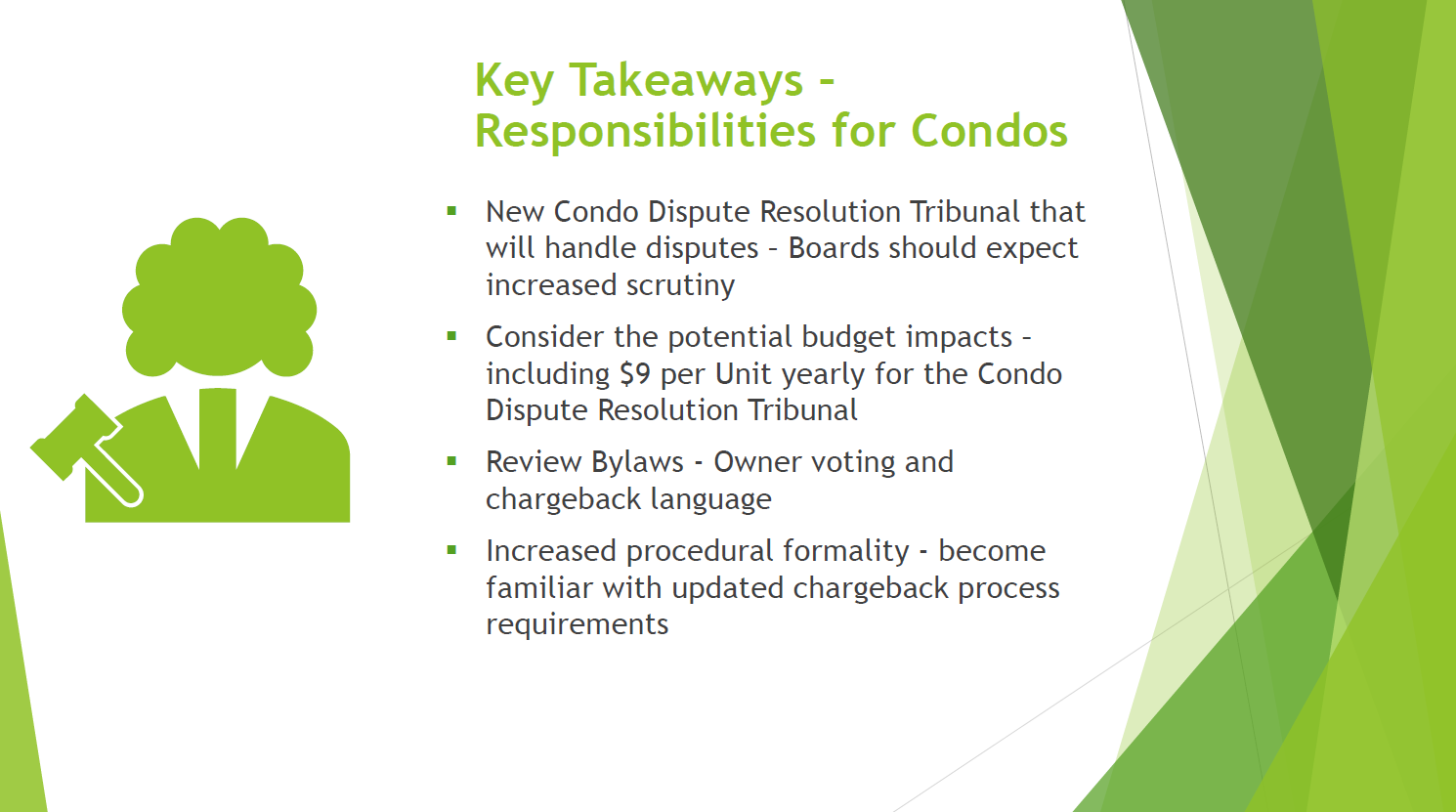
This is still a transition period. Many aspects of the new system will become clearer over time as more cases are handled.
Q&A
1. Who pays tribunal fees?
The applicant is responsible for the application and adjudication fees. Mediation costs are shared between the parties, although the tribunal may have discretion to adjust or waive fees depending on the situation.
2. Can the tribunal handle improperly registered bylaws?
This is likely not under its current jurisdiction. These types of issues would typically need to be addressed through the court system.
3. How long does it take to get a hearing?
There is no defined timeline for scheduling a hearing. The only requirement is that a decision must be issued within 60 to 90 days after the hearing takes place.
4. Will boards need legal representation?
While not required, legal support is expected to be common, particularly for more complex disputes.
5. Are interest charges on arrears still allowed?
Yes, provided they are permitted within the corporation’s bylaws.
6. Are there penalties for boards acting in bad faith?
There are no new specific penalties, but courts still retain discretion to award costs in appropriate cases.
7. Are there any tribunal statistics yet?
No decisions or data have been published yet, as the tribunal is still in its early stages.
8. Who represents the corporation at the tribunal?
Typically, a board member, unless a lawyer or other representative is appointed. Property managers act as agents but are not the default representatives.
9. Does Bill 30 affect foreclosure for unpaid fees or assessments?
No, existing collection and enforcement processes remain unchanged.
10. Does the new technical audit requirement apply to older buildings?
No, it only applies to developments where first occupancy occurs after February 16, 2026.
11. Can owners vote while involved in a tribunal dispute?
Yes, unless they are in arrears, which would still disqualify them from voting.
12. What happens if a chargeback notice is not sent within 90 days?
This could create complications, as the legislation requires strict adherence to timelines. Boards must ensure they follow the proper process.
13. Will the tribunal enforce its decisions?
No, enforcement must be pursued through the courts by the successful party.
14. Will disputes increase under the new system?
Based on experience in other provinces, dispute volumes are expected to increase due to easier access to formal resolution.
Further Resources:
- SVR Lawyers
- Condominium Property Act
- Condominium Dispute Resolution Tribunal
- Register for future webinars: https://magnumyork.com/webinar/
- SVR Lawyers: Bill 30 and New Condominium Regulations – What Boards and Managers Need to Know
- Webinar Recap – Where Do Your Condo Fees Actually Go? Decoding Your Budget with Magnum York
